Evaluate an IoT exhibitor with a pilot that can reveal failure
A live sensor reading is a useful opening to an exhibitor conversation. A deployment decision needs more: a reproducible explanation of that reading, evidence from representative conditions and a clear account of what happens when the chain fails. Organize the evaluation around the task your organization needs to complete, then ask the provider to show the relevant interfaces and responsibilities.
GlobalSat’s contemporary exhibitor announcement identifies Sigfox Connect in Berlin on 24–25 October 2018. That is historical context for this exhibition URL. This independent guide does not offer current stand bookings or reuse the old event’s contact details.
Trace one reading from the physical input to a decision
Choose a reading whose origin you can understand. Ask what was measured, which device and firmware produced it, how it was encoded, where it was received and what caused the displayed result to change. A simulated input can be perfectly useful for explaining an interface, provided the demonstration identifies which stages are simulated.
| Stage | Evidence to request | Question it resolves |
|---|---|---|
| Physical observation | Input condition, sensor model and sampling behavior | What does the number represent? |
| Encoded message | Raw bytes and the applicable schema version | Can another decoder reproduce it? |
| Received record | Device identity and available timing metadata | Which observation arrived, and when? |
| Application processing | Validity, duplication and stale-data rules | Why was this value accepted? |
| Operating response | Notification, acknowledgement and action record | Did the information lead to the required action? |
At each handoff, identify an owner. A device supplier may be responsible for firmware while another company supplies the application and a local team owns the response. “The platform handles it” is insufficient if no one can say which support route investigates an observation missing between two systems.
Design a pilot with an honest denominator
Before installing devices, agree on what makes an observation due and which outcomes count. For periodic reporting, the expected schedule may supply a denominator. For event-driven reporting, you may need an independent event log. Counting only received messages cannot reveal events that were never detected or transmitted.
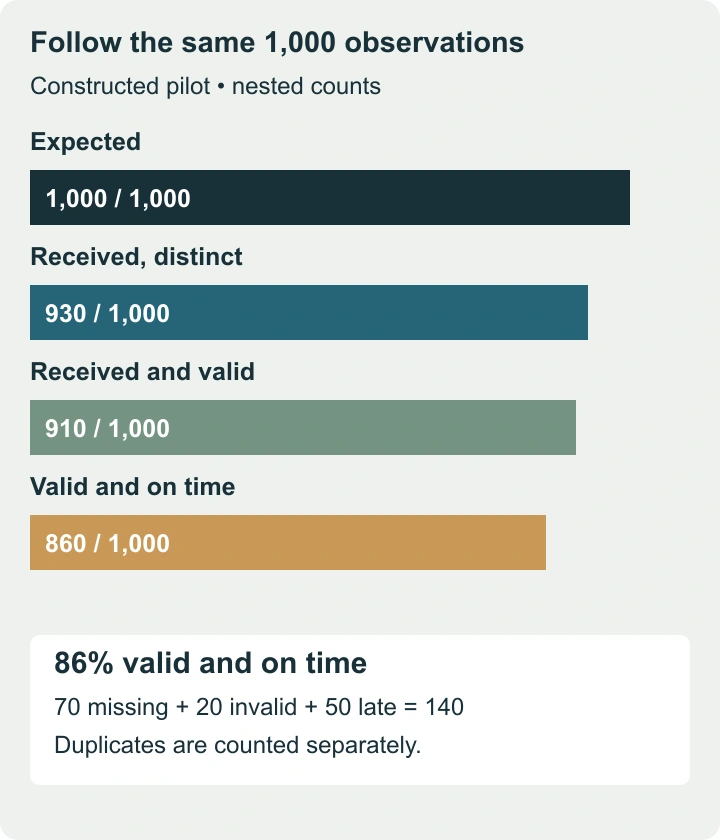
In a constructed pilot, 1,000 observations are expected. The application receives 930 distinct observations; 910 pass the agreed validation rules; 860 of those valid observations arrive within the agreed deadline. These are nested groups, and each percentage below uses the original 1,000 expected observations.
| Outcome | Count | Share of expected observations |
|---|---|---|
| Valid and on time | 860 | 86% |
| Valid but late | 50 | 5% |
| Received but invalid | 20 | 2% |
| Not received | 70 | 7% |
| Total expected | 1,000 | 100% |
Reporting only “97.8% valid” would divide 910 by the 930 received observations. That can be a useful decoder-quality measure, but it omits missing observations and says nothing about timeliness. Reporting 86% valid and on time answers a different operational question. Neither percentage has meaning without its definition.
Keep duplicate receptions separate from distinct observations. If 20 duplicate records also arrive, there are 950 received records but still only 930 distinct observations. Deduplicate using the application’s documented identity rules; do not assume that a small counter remains unique across device replacements, restarts or wraparound.
Make the installation resemble the intended use
Record locations, enclosure, mounting, orientation, regional configuration, firmware and the reporting policy. Sigfox’s regional radio configurations are a reason to check the actual proposed device setup. A successful exhibition demonstration does not establish reception in another region or inside your final installation.
Include representative difficult locations from the start. If a site is removed because installation is impractical, record that as an outcome and show how it affects the deployment decision. It should not silently vanish from the population you originally promised to evaluate.
Timing also needs a definition. “Within five minutes” could mean from physical occurrence, acquisition, transmission or backend receipt. Choose the reference that matters to the task and explain how it is observed. If acquisition clocks are not trustworthy, a dashboard timestamp alone cannot prove end-to-end delay.
Ask for controlled failures with expected outcomes
Agree on tests in an authorized pilot environment. Do not interfere with a live service or attempt unauthorized radio disruption. Many useful checks can be performed with a test device, controlled input or application test interface.
| Test | Expected observable behavior | Evidence to retain |
|---|---|---|
| Inject a documented invalid test message | Rejection is recorded; the display does not invent a normal reading | Payload, rejection reason and displayed status |
| Restart a test device | Identity and counter behavior match the specification | Before-and-after records and firmware version |
| Pause a test application connection | Missing or delayed processing is visible; recovery follows the stated policy | Interruption times, recovered records and any losses |
| Leave a test alert unacknowledged | The agreed escalation occurs, or its absence is documented | Notification and acknowledgement history |
| Replace a device in the application | Historical records remain distinguishable from the replacement’s data | Identity mapping and retained history |
Write the expected behavior before the test. Otherwise it is easy to describe any result as acceptable after seeing it. A failure should identify the blocked requirement, the responsible party and the proposed correction. Re-run the relevant test after that correction and retain both results.
Ask about the whole product’s security and support
NISTIR 8259A provides six useful capability headings: device identification, configuration, data protection, logical access to interfaces, software update and cybersecurity state awareness. They help structure questions; mentioning the document does not certify an exhibitor’s product or determine all requirements for your use.
Turn those headings into evidence requests. Ask how authorized users are distinguished, which interfaces can be disabled, which components can be updated and how a customer learns about a security-relevant event. Where the device cannot be remotely updated, ask what maintenance or replacement process exists and what its operational limits are. A claim about one radio link does not answer questions about the web account or supporting application.
Request a support period and a practical end-of-support procedure for the proposed product version. A promise that “updates are available” leaves important questions unanswered: available to whom, through which mechanism, at what cost and with what interruption? Record commitments in the proposal or contract rather than relying on a conversation at a stand.
Plan the pilot’s exit before it starts
- Specify the data you need to retain, including raw observations where appropriate, interpreted values, device mappings and the definitions used for the results.
- Test an export early.
- Open it independently and check its units, timestamps, row count and identifiers.
A screenshot proves that a dashboard existed; it is a poor substitute for a usable observation record.
For an invented seven-day trial with 10 devices and 20 planned observations per device per day, the schedule implies 1,400 expected observations. If the export contains 1,350 rows, the count alone does not reveal whether 50 are missing: duplicates, test records and exclusions may also affect it. Reconcile the schedule, identity rules and export contents before accepting a headline result.
Decide who removes accounts, returns or reassigns devices and retains records if the trial stops. If it proceeds, define the installation changes or unresolved failures that must be addressed first. Use the pilot evidence worksheet to record those decisions.
End with a bounded acceptance decision
The conclusion should say what was demonstrated, under which conditions, and which requirements remain open. There is no universal success percentage for all sensing tasks. A slowly updated inventory observation and an urgent operational alert need different evidence and consequences for missed data.
A good exhibitor evaluation can therefore end in acceptance, a smaller revised use, another targeted test or rejection. What matters is that the decision follows the agreed evidence. The most useful demonstration is one that leaves you able to reproduce the result and recognize the conditions under which it should no longer be trusted.