Build an IoT Battery Budget You Can Check
A battery-life estimate should explain where charge goes. Dividing the number printed on a cell by an average current copied from a radio brochure misses the sensor, processor, regulator and the way the device actually behaves between messages. Start with a daily charge budget, then use measurements to replace its assumptions.
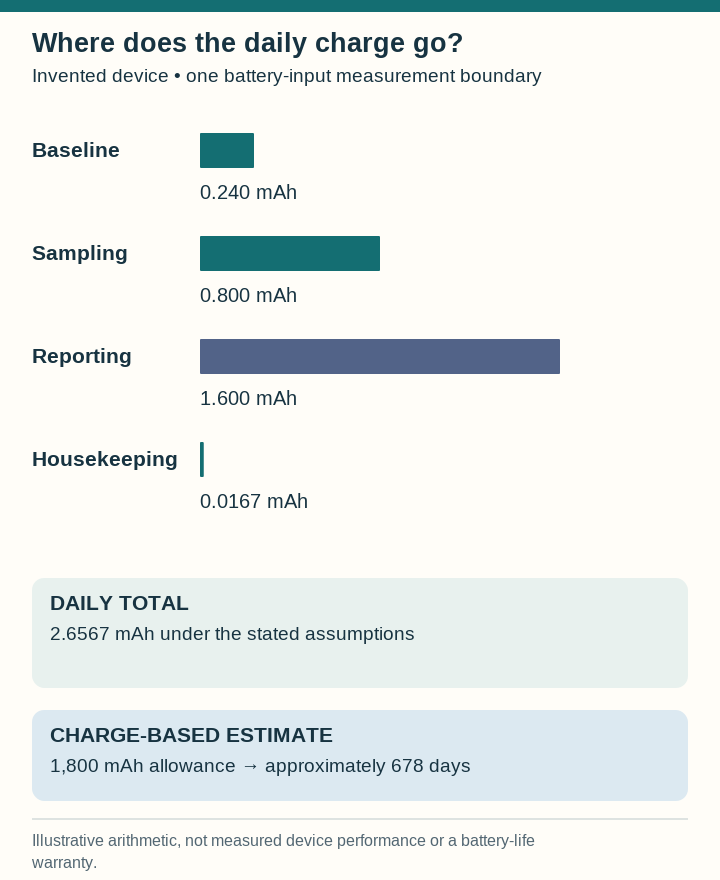
The calculation below is an invented engineering example for a small monitoring device. It is not a measured Sigfox product or a recommended battery. Its purpose is to make the largest consumers visible and to show which design changes deserve testing before anyone promises years of operation.
Choose one electrical boundary
Measure and budget at a stated point, ideally the battery input when predicting battery demand. A current measured on a regulated sensor rail cannot simply be added to battery current at a different voltage. Conversion efficiency and the regulator’s own consumption affect the relationship. If measurements use different supply rails, first reconcile them as power or energy at the chosen boundary.
For this example all currents are defined at the same battery input. A continuous baseline is counted for the entire day. Every active current in the table is an increment above that baseline, so active periods do not count the baseline twice. An alternative model uses mutually exclusive operating states; either method can work, but mixing the two produces an inconsistent total.
Build the daily charge budget
Charge in milliampere-hours equals current in milliamperes multiplied by time in hours. Divide seconds by 3,600 before multiplying. Keep the unrounded values through the calculation and round only the displayed result.
| Contribution | Assumed current and duration | Daily occurrences | Charge per day |
|---|---|---|---|
| Continuous baseline | 0.010 mA for 24 hours | Continuous | 0.240 mAh |
| Sensor and processing increment | 5 mA for 2 seconds | 288 | 0.800 mAh |
| Reporting-cycle increment | 40 mA for 6 seconds | 24 | 1.600 mAh |
| Daily housekeeping increment | 20 mA for 3 seconds | 1 | 0.0167 mAh |
| Total | Under these assumptions | One day | 2.6567 mAh |
The sensor runs every five minutes, while reporting happens hourly. Those are separate schedules. The reporting-cycle assumption must include all activity assigned to that cycle, including any repetitions and receive activity actually used by the design. It is not a claim that a Sigfox transmission universally lasts six seconds or consumes 40 mA.
With an assumed usable charge allowance of 1,800 mAh, the arithmetic gives 1,800 ÷ 2.6567, or approximately 678 days. The allowance is an input to this teaching model, not a universal fraction of nominal capacity. The result is a charge-based estimate, not a service-life warranty.
Change a requirement before changing a component
Reporting uses the most charge in this example, but that does not automatically make fewer reports the right decision. A longer reporting interval may make information too old for its intended task. Compare alternatives against the observation requirement, not just against battery demand.
| Case | Daily demand | Calculated duration, rounded | Question to resolve |
|---|---|---|---|
| Original assumptions | 2.6567 mAh | 678 days | Are the currents and activity times measured? |
| 12 reporting cycles per day | 1.8567 mAh | 969 days | Can the task tolerate the new reporting schedule? |
| Sensor sampled every ten minutes | 2.2567 mAh | 798 days | Could shorter events now go unobserved? |
Reducing sensor sampling is particularly easy to misunderstand. A device may transmit the same number of messages while becoming less capable of detecting a brief event. Conversely, keeping frequent local sampling and reporting a suitable summary may preserve useful information, provided the device implements the required storage and summary correctly. The local buffering guide explains the storage side of that decision.
Check the pulse, not only the daily total
Sigfox’s development guidance highlights sensors that remain powered, temperature, regional configuration and the power source’s ability to support transmission demand. These are reasons to examine the actual circuit and cell together. A source can have enough nominal charge yet fail to maintain the voltage required during an active pulse.
Test the intended assembly with its actual supply path and operating limits. Record voltage during active periods as well as integrated charge. A laboratory supply can hide behavior that appears with a battery, connector or aged power path. The test should establish whether the device completes its task and returns to its expected low-power state.
- Measure the baseline after startup and after ordinary activity.
- Capture an entire reporting cycle rather than a selected low-current segment.
- Check sensor startup and stabilization time before assuming a short measurement window.
- Repeat relevant measurements over the intended operating conditions.
Include exceptional behavior in the model
A device that wakes repeatedly because of a noisy input may spend much more time active than the nominal schedule predicts. A firmware fault can leave a peripheral powered. A maintenance operation may create a burst of reporting. Record these as separate scenarios rather than hiding all uncertainty inside an unexplained safety factor.
For each scenario, write what triggers it, how long it can last and what bounds its activity. A retry policy needs a stopping condition. A low-battery report needs enough reserve to be useful before the device becomes unreliable. Neither policy should be inferred from a successful bench demonstration.
Turn the estimate into a maintenance decision
Keep the measured traces, firmware version, sampling policy and battery assumptions beside the spreadsheet. Recalculate when a release changes activity. Use the schema and firmware rollout guide to make that change visible, and the commissioning record to associate the deployed device with the right configuration.
The final maintenance interval also depends on access, inspection opportunities, acceptable uncertainty and the consequences of a missed observation. A useful battery budget therefore ends with two outputs: a reproducible charge calculation and a list of measurements still needed before choosing the replacement schedule. Improving the estimate means reducing those uncertainties, not adding decimal places to an unverified current.