When sensor data saves work: build an honest IoT value case
Installing sensors creates observations. Operational value appears only when those observations change a decision or a task in a useful way. A project can transmit accurate data and still add work if staff must check the dashboard, investigate frequent false alarms and continue the original inspection routine.
This page presents an independent framework for evaluating that change. Its historical address hosted an editorial by Ludovic Le Moan about turning IoT data into value. The analysis below is new editorial work, not a reproduction of his article. All numerical cases are constructed examples, with assumptions stated so the calculations can be changed.
Describe the action, not just the measurement
Write the proposed chain as observation, interpretation, decision, action and result. For example, a container sensor reports a condition; an application classifies it as requiring attention; a dispatcher decides whether to change a route; a crew makes the visit; the organization records the service outcome and time used.
Each step can fail independently. A correct reading may be too late for route planning. A correct alert may be ignored because no one owns it. A timely action may deliver no labor saving if the crew still visits the location for another task. Identifying the weakest step is usually more productive than adding precision to an already adequate measurement.
| Element | Useful definition | What would weaken the claim |
|---|---|---|
| Task to change | Routine checks of a defined set of assets during a defined period | Other tasks still require the same visits |
| Decision | Which assets require a visit before the next service window | Readings arrive after the route has been fixed |
| Outcome | Staff time, service quality and missed conditions recorded together | Time falls only because service quality deteriorates |
| Comparison | The prior process or a suitable comparison group with the same boundary | Different asset counts, periods or service obligations |
Build a baseline from work that actually happens
Suppose a team performs 300 checks per period and each takes 10 minutes, including the travel and recording work assigned to that check. The baseline is 3,000 minutes, or 50 hours. That is a starting estimate to verify with observation, not a claim that every check consumes exactly 10 minutes.
Be explicit about shared time. If a worker visits five assets in one trip, adding the entire journey to each check would count it five times. Conversely, recording only the minute spent looking at a sensor can omit preparation and travel. Choose a consistent boundary and use it for both the original and proposed processes.
Separate routine checks from exceptions. A service process with unusually few problems during the pilot may look efficient even if the technology made no difference. Retain counts of assets, shifts, genuine incidents and any material operating changes alongside hours worked.
Work through recurring and first-period time separately
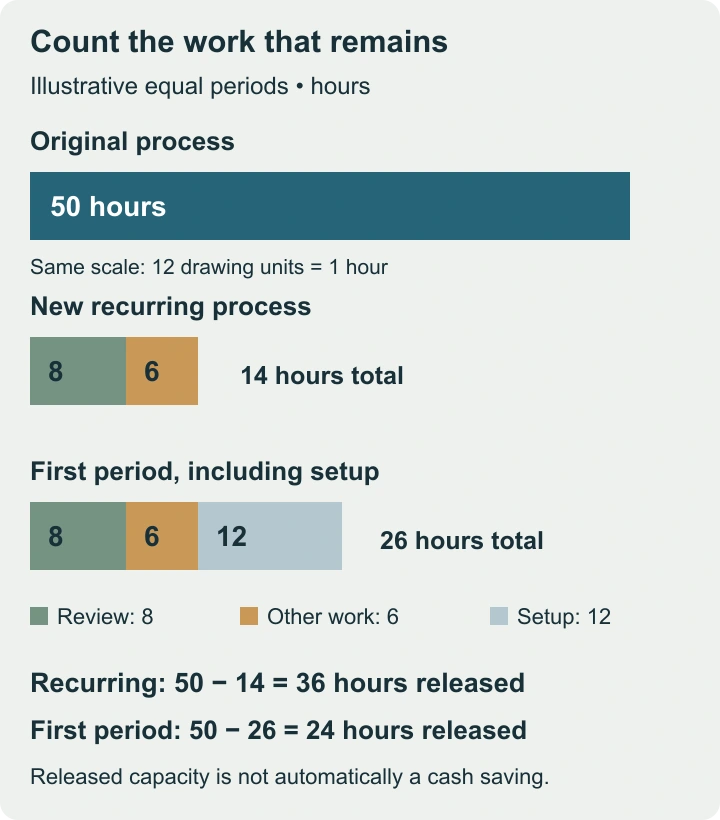
Assume the proposed process replaces those routine checks but requires 8 hours of dashboard review and 6 hours of maintenance and exception handling in each comparable period. It also requires 12 hours of one-off setup. The arithmetic is:
| Item | Recurring period | First period including setup |
|---|---|---|
| Original process | 50 hours | 50 hours |
| Review | 8 hours | 8 hours |
| Maintenance and exceptions | 6 hours | 6 hours |
| Setup | 0 hours | 12 hours |
| Total proposed work | 14 hours | 26 hours |
| Capacity released | 36 hours | 24 hours |
The recurring reduction is 50 − 14 = 36 hours, or 72% of the baseline. The first-period reduction is 50 − 26 = 24 hours, or 48%. Presenting the larger percentage as the immediate first-period result would hide setup work. Use the pilot time calculator to change the assumptions and retain both results.
Multiply 36 hours by an illustrative loaded labor rate of 25 currency units per hour and the released capacity is valued at 900 currency units per period. That is not automatically a 900-unit reduction in spending. If staffing and paid hours stay unchanged, the organization has gained capacity that must be used productively to deliver the expected benefit.
Keep capacity, cash and service benefits in separate accounts
Cash savings require an identifiable spending change: for example, fewer paid overtime hours or an avoided external service charge. Released salaried time belongs in a capacity account until the organization explains how it will be used. Faster detection or more consistent records can be valuable too, but those benefits need their own measures rather than being added as invented monetary amounts.
Do not count the same benefit twice. If a worker uses the 36 released hours to complete a backlog, reporting both the full notional labor saving and the value of all additional work as independent gains may overstate the result. Describe the chosen valuation method and the actual operating change.
Hardware, installation, connectivity, software, replacements and support are separate costs. The time example is not a complete return-on-investment calculation. A project with positive time savings can still be economically unattractive after those costs, while a project with little labor saving may be justified by a separately established service requirement.
Stress-test the two assumptions most likely to break
First, increase maintenance and exception handling from 6 to 20 hours. With review still at 8 hours, recurring work becomes 28 hours and released capacity falls to 22 hours. The system still saves time under these assumptions, but less than the initial 36-hour claim.
Second, suppose 150 of the original 300 checks must continue because they also perform another necessary task. At 10 minutes each, the remaining manual checks add 25 hours. Add the original 14 hours of new recurring work and the total becomes 39 hours: only 11 hours are released. This is why “sensors replace inspection” must be tested at the level of actual tasks.
| Case | New recurring work | Capacity released from 50 hours |
|---|---|---|
| Initial assumptions | 14 hours | 36 hours |
| Exceptions and maintenance rise to 20 hours | 28 hours | 22 hours |
| Half of the manual checks remain | 39 hours | 11 hours |
| Both adverse assumptions occur | 53 hours | −3 hours: additional work |
Measure missed conditions as well as unwanted alerts
An alert count does not show whether the system finds the conditions that matter. In a constructed trial, independent review identifies 40 situations requiring action. The system alerts on 34 of them and misses 6. It also generates 16 alerts when no action is needed.
There are 50 alerts in total. Of those, 34 are useful: 68%. Of the 40 genuine situations, 34 are detected: 85%. These percentages answer different questions. The first describes the proportion of alerts that correspond to real needs; the second describes the proportion of real needs detected. Neither establishes how quickly staff responded or whether their action worked.
The missed-condition denominator requires independent checking. If the pilot only investigates generated alerts, it cannot discover all the situations that generated no alert. Decide how the reference observations will be collected before the trial and count that evaluation effort separately from normal future operations.
Use a pilot to decide, not merely to demonstrate
- Choose a period that includes the conditions the service is expected to handle.
- Record baseline work, new work, genuine events, missed events and service outcomes under the same definitions.
- Where practical, compare similar assets or periods; describe remaining differences rather than pretending the pilot is a controlled experiment when it is not.
Finish with three decisions: which original tasks can safely stop, which new tasks need an owner, and which uncertain assumptions deserve another test. If the original routine must remain unchanged, revise the value case immediately. The strongest case for an IoT project is a documented improvement in a real operating process, with the work and limits counted alongside the benefits.