Build an IoT learning agenda around decisions you need to make
An IoT conference is most useful when you leave with a better decision, not simply more product names. Before choosing sessions, identify the uncertainty that is preventing a project from moving forward. A team that already understands message encoding may need evidence about installation and maintenance; a team with a good field prototype may need to work out who responds to its alerts.
The historical Sigfox Connect page advertised a virtual event on 18–19 November 2020 under three theme headings: Re-imagine, Re-design and Re-invent. The event producer, Groovy Gecko, describes prerecorded presentations, live questions and an online conference environment. That record explains the event’s format. This page is an independent learning guide, not a current timetable, booking page or promise that those recordings remain accessible.
Start with a decision small enough to resolve
“Understand IoT” is too broad to guide an afternoon. “Decide whether to test a door-state sensor in two storerooms” gives you a boundary. It identifies a proposed observation, a location and a next step without assuming that a purchase is already justified.
Write the brief in four sentences:
- what currently happens,
- what decision the observation could improve,
- what remains uncertain
- and what evidence would change your mind.
Include the person who would use the result. If nobody can explain what happens after a sensor reports a condition, a session about operating practice may be more valuable than another hardware demonstration.
| Brief field | Specific entry | Consequence for the agenda |
|---|---|---|
| Present process | A staff member checks whether two doors are closed at the end of a shift | Understand the current check before proposing replacement |
| Potential decision | Ask the duty person to inspect a door that remains open after closing time | Study the alert and response workflow |
| Uncertainty | Installation position and ownership of out-of-hours exceptions | Prioritize field evidence and operations |
| Next decision | Approve a bounded trial, revise the use or stop | Seek evidence sufficient for a trial, not an organization-wide rollout |
Allocate time by the missing evidence
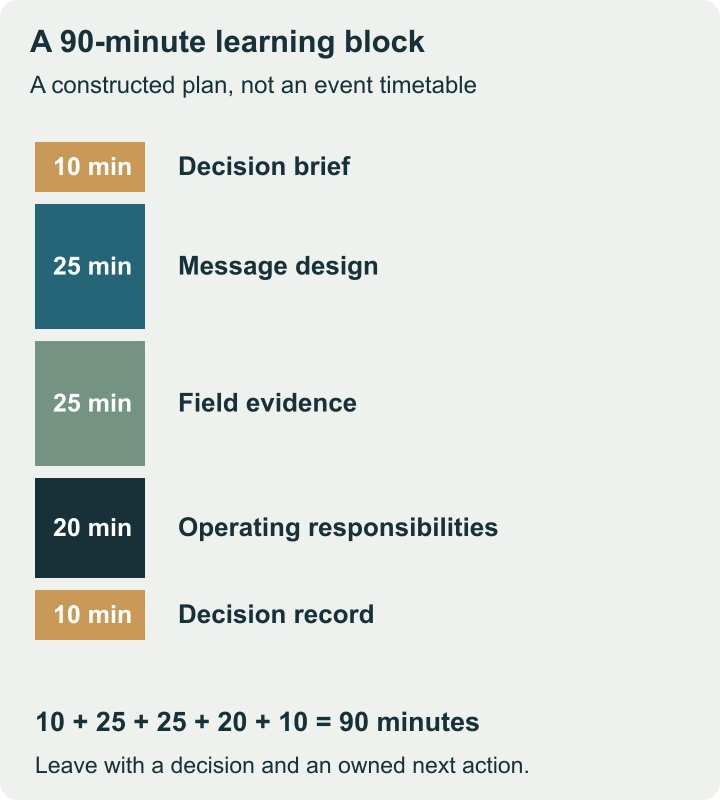
A short plan makes trade-offs visible. The following 90-minute example could be used for recorded talks, a reading session or an internal workshop. It is deliberately not a reconstruction of a historical event agenda.
| Minutes | Activity | Output to retain |
|---|---|---|
| 0–10 | Agree on the decision brief | One uncertainty and one decision owner |
| 10–35 | Study message and integration design | A sample observation with units, validity and timing explained |
| 35–60 | Read deployment evidence | The tested environment and a list of differences from your site |
| 60–80 | Examine operating responsibilities | Who handles absence, faults and replacement |
| 80–90 | Write the decision record | What was learned and the smallest useful next action |
The time allocations total 90 minutes; they are not a recommended universal balance. If the message format is already understood, move that time to the missing subject. Preserve the closing decision slot. Without it, a session can end with everyone agreeing that the material was interesting while nobody knows what has changed.
Take notes that preserve the meaning of a claim
Record a claim together with its object, conditions, period and denominator. “Ninety-eight percent success” is incomplete. It might describe delivered messages, devices heard at least once, locations passing an installation test or alerts acknowledged by staff. Those are different measurements.
Consider a fictional presentation reporting that 98 of 100 installed devices communicated at least once during a week. That supports a 98% “devices heard” result for that observation period. It does not establish that 98% of scheduled observations arrived, that every room was covered or that alerts arrived before an operational deadline. One device sending a single message can satisfy the first measure while failing a much more demanding service requirement.
Preserve the original claim in your private note, then write your interpretation separately. For example: “The result shows initial communication at most tested devices; observation completeness remains unreported.” This prevents the project’s later slide deck from accidentally strengthening what the speaker actually demonstrated.
Compare settings before comparing percentages
A case study becomes useful when its differences from your project are explicit. Sigfox’s radio configuration documentation describes region-dependent configurations; the right hardware and regional setup therefore belong in the comparison. Similar logos or device shapes are not enough to establish that two deployments have the same technical conditions.
| Difference to examine | Example of a misleading shortcut | Useful follow-up |
|---|---|---|
| Physical setting | Outdoor reception is treated as evidence for a basement room | Request the installation conditions and design a site check |
| Observation schedule | One daily reading is compared with exception-triggered events | Identify how observations become due and what counts as missing |
| Time requirement | Eventually received data are described as timely alerts | Record the task’s deadline and how elapsed time was measured |
| Human response | A dashboard change is treated as an action completed | Find out who saw it and what they did |
| Trial boundary | Failed sites disappear from the final percentage | Ask for initial and final site counts and reasons for exclusions |
Some differences cannot be resolved from a talk. Mark those as test requirements. If the material demonstrates a useful method but not your exact conditions, record both conclusions: the method is informative, and its performance in your setting is still unknown.
Three useful learning outcomes
A representation question becomes a small technical task
A team discovers that its proposed message needs a missing-reading state, but the example schema has none. The useful outcome is not “we attended the payload session.” It is a revised schema decision: define the missing state, add a version rule and agree on fixed test vectors. A developer can complete that bounded task before hardware is ordered.
A deployment claim becomes a comparison plan
A presenter shows success in an open warehouse. Your installation is inside a closed metal cabinet. You cannot infer reception through the cabinet from the warehouse example. The next action is to test the intended enclosure and position, or investigate a permitted installation change. The session has narrowed an uncertainty even though it has not resolved it.
A business story exposes an operating gap
A case study describes reduced inspection work, but the proposed project still requires a staff member to perform the original round for other reasons. The expected labor reduction may therefore be smaller than the story suggests. Ask which tasks would actually disappear, which remain and which new tasks the system creates. That can change the pilot objective from “remove the round” to “identify exceptions earlier.”
Divide the listening, then reconcile the findings
For a small team, assign distinct questions rather than asking everyone to watch everything. One person follows the observation and data contract; another follows the physical deployment; a third follows the operating process. Each should return with a short claim-and-evidence note, not a full transcript.
Use the same project brief when reconciling the notes. A device specialist may report that the measurement is feasible while an operations colleague reports that no one can respond overnight. Those findings are compatible: technical feasibility has improved, but the operating requirement remains unresolved. The decision record should preserve both instead of flattening them into a single optimistic verdict.
Finish with a decision record, including what remains open
A useful record has five fields: question, finding, evidence limitation, next action and owner. Replace “contact supplier” with something testable, such as “obtain the documented reboot behavior for the proposed firmware version.” Replace “research coverage” with “check the intended configuration in both rooms with the actual enclosure.”
Give each uncertainty a status: resolved for this decision, partially resolved or still open. “Resolved” does not mean true in every future deployment; it means the evidence meets the boundary of the current decision. Note that boundary so the conclusion is not reused months later for a different building or device version.
If a historical recording is missing, do not reconstruct what its speaker supposedly said. Use surviving program information to understand the topic, then obtain the technical evidence independently. The best result from a learning agenda can be a carefully justified decision to revise or stop a proposal before a larger commitment is made.