IoT Device Commissioning and Replacement Without Lost History
Commissioning connects a physical device to a real asset, a data contract and an operating owner. A device that appears in a backend is not necessarily ready for service. It can still be attached to the wrong asset, use the wrong decoder or have no agreed response when its observations stop.
This guide treats commissioning as a short evidence trail. The examples use fictional asset and device labels. They contain no credentials and do not perform registration, transfer or subscription changes.
Keep the asset and the device separate
An asset identifier describes the thing or location being monitored. A device identifier describes the particular electronic unit making observations. An installation record connects the two during a stated period and records the mounting arrangement and configuration. Replacing a device should change that relationship without erasing the asset’s history.
For example, asset CAB-017 may remain the same cabinet while fictional device UNIT-A is replaced by UNIT-B. These are teaching labels, not valid registration credentials. Avoid using the cabinet’s friendly name as the only key for device messages; names can be edited or reused.
| Record group | Useful fields | Acceptance evidence |
|---|---|---|
| Physical assignment | Asset, device and installation position | The observed unit matches the recorded mapping |
| Technical configuration | Hardware variant, firmware and schema | A known input produces the expected interpreted result |
| Operating policy | Schedule, freshness rule and alert owner | The application shows correct normal and unavailable states |
| Maintenance | Responsible team and replacement route | A person can locate and service the installed unit |
| History | Start, end and change reason | Later observations can be assigned to the correct installation |
Keep identification separate from authorization
Sigfox distinguishes a device ID from its Porting Authorization Code, or PAC. Its documentation states that the PAC changes after first registration or re-registration in another independent group and warns against publishing it or printing it on the device. A visible asset label should therefore not become a convenient place to expose ownership-transfer information.
Keep the ordinary installation inventory useful without including secrets that most users do not need. A technician may need the device identity, mounting photo and maintenance instruction while an authorized account administrator manages registration information separately. Define who can retrieve that information and through which approved process.
Do not assume an old onboarding spreadsheet still contains the current PAC. Resolve ownership and registration questions using the authorized current record. This guide’s commissioning checks concern the evidence trail; they do not replace the provider’s current administrative procedure.
Commission one unit end to end
- Identify: compare the physical unit and its recorded identifier before mounting.
- Assign: create the intended asset-to-device relationship with a start boundary.
- Configure: confirm the device and receiver agree on the schema and schedule.
- Observe: use an appropriate known condition or authorized test input.
- Trace: follow the resulting record through reception, decoding and display.
- Hand over: confirm the owner can find the unit and understand unavailable data.
The test input should be appropriate to the equipment and its operating constraints. A simulated reading can test software interpretation if labeled as simulated; it cannot establish that the installed sensor measures the real condition correctly. Retain which boundary each test actually exercised.
Use the selected setup from the installation survey. If commissioning changes the enclosure or mounting position, the earlier field evidence may no longer describe the deployed arrangement. Record the change and determine which checks need repeating.
Replace a unit without rewriting the past
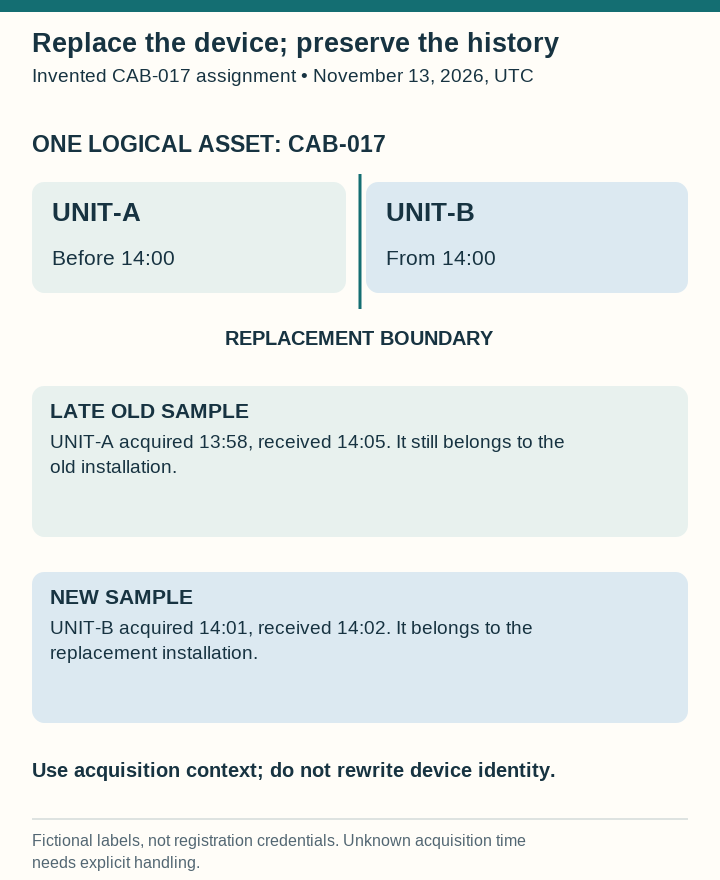
Suppose the planned replacement boundary for CAB-017 is 14:00 UTC on November 13, 2026. The old installation ends at that boundary and the new one begins there. Use a clearly documented interval convention; in this example the end is excluded and the start is included.
| Record | Relevant time | Interpretation |
|---|---|---|
| UNIT-A installation | Before 14:00 UTC | Old unit assigned to CAB-017 |
| UNIT-B installation | From 14:00 UTC | Replacement assigned to CAB-017 |
| UNIT-A sample received at 14:05 | Acquired at 13:58 UTC | Historical sample from the old installation |
| UNIT-B sample received at 14:02 | Acquired at 14:01 UTC | Sample from the new installation |
The late old sample should not be relabeled as if it came from the new unit. The timestamp guide explains why acquisition and receipt serve different purposes. If acquisition time is unknown, preserve that ambiguity rather than using receipt time as an undocumented substitute.
A planned overlap during handover can be legitimate, but it needs an explicit rule for which unit supplies the operational view. Do not let two simultaneously installed units silently overwrite one another under the same asset key. Their independent records can be useful for comparison while the application chooses a stated primary source.
Check the service-side replacement separately
The documented Sigfox replacement operation has conditions, including a target device without a valid token; it also states that the transferred subscription period is unchanged. Those details show why a physical swap and an administrative replacement are separate tasks. Confirm the applicable current procedure and entitlement before an authorized administrator performs it.
A successful backend change does not verify the new unit’s mounting, measurement or decoder. Conversely, a successful physical test does not prove that the intended subscription and support arrangements are correct. Record both outcomes without treating either as a substitute for the other.
Report batch progress by acceptance state
In an invented batch of twelve delivered units, ten pass commissioning, one has an unresolved physical label and one fails the application handoff. The useful report is ten accepted and two blocked, with reasons and owners. Calling all twelve deployed because they arrived on site hides unfinished work.
Use the callback checks for the failed handoff and the version record for future changes. Close commissioning only when the evidence and operating responsibility are complete enough for the stated use. That record is what makes the second technician’s visit easier than the first.