IoT Schema Rollouts: Compatibility, Staging and Recovery
A new firmware release can be correct on its own and still break the deployed data path. Devices, decoders, stored records and application rules do not necessarily change at the same moment. Plan a schema rollout around the combinations that will coexist, including the ones needed after a rollback.
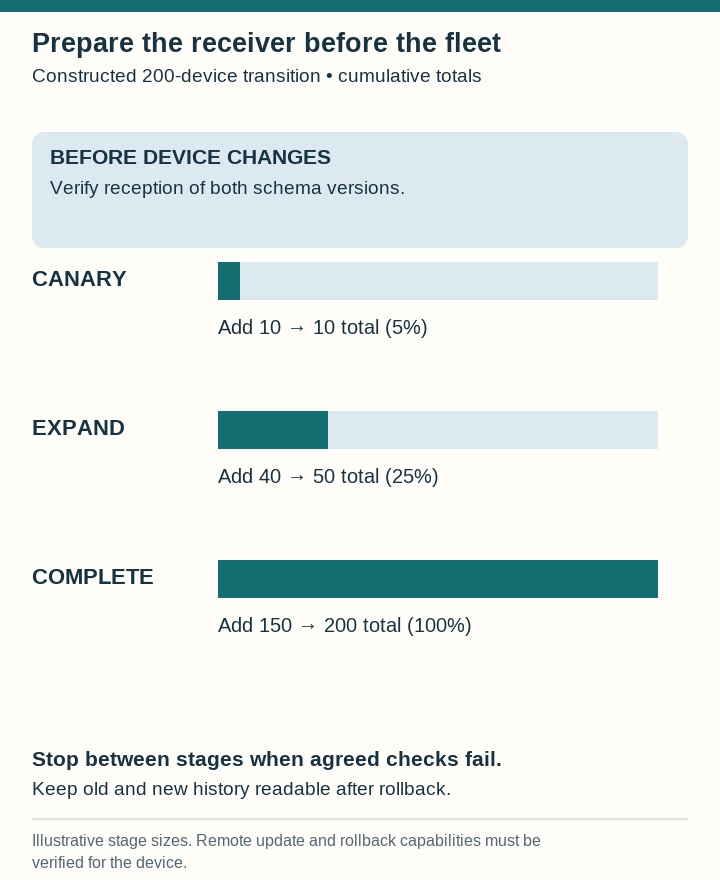
This guide uses a constructed fleet of 200 devices. Its rollout sizes are examples, not a universal release policy. The central problem is compatibility: how to introduce a new observation format while keeping existing devices and historical data understandable.
Keep three versions distinct
A firmware version identifies a software release. A schema version identifies the meaning of a message. A decoder version identifies the implementation interpreting it. These can change independently. A firmware bug fix may preserve the schema; a decoder correction may change an interpreted result without changing the original bytes.
Record these distinctions in the inventory and processing history. A label such as “version two” is ambiguous unless it says which layer it describes. Keep the raw observation, declared schema and the decoder revision used to interpret it where the application’s retention policy permits.
| Change | Possible effect | Evidence required before release |
|---|---|---|
| Firmware changes sampling timing | Same bytes, different observation schedule | Timing and energy checks, not just codec tests |
| Schema adds validity flags | New layout or interpretation | Version discrimination and valid/invalid vectors |
| Decoder fixes signed arithmetic | Corrected values from unchanged input | Known-result tests and a reprocessing policy |
| Alert rule changes thresholds | Different decisions from the same value | Rule-version record and state-transition tests |
Write the compatibility matrix first
The existing six-byte payload workshop has an explicit version field. Imagine a proposed second schema adding a separately defined validity representation. This article does not silently redefine that workshop’s version-one bytes. The new contract must specify its own exact length, fields and rejection rules.
| Input | Old receiver: version one only | Prepared receiver: versions one and two |
|---|---|---|
| Valid version-one observation | Decode as version one | Decode as version one |
| Valid version-two observation | Reject or quarantine visibly | Decode under the new contract |
| Unknown version | Reject or quarantine visibly | Reject or quarantine visibly |
| Declared version with wrong length | Reject where unsupported or malformed | Reject; do not guess from plausible values |
Deploy and verify the prepared receiver before allowing version-two messages from the fleet. Otherwise the first updated device can create an application outage despite communicating normally. Acceptance of the envelope and successful interpretation remain separate outcomes, as explained in the callback guide.
Use a rollout that can stop
In the fictional 200-device fleet, update ten devices first: 5% of the fleet. After the agreed checks pass, update forty more, reaching fifty devices or 25%. The remaining 150 form the final stage. These counts make the transition explicit; they do not establish that ten devices are statistically representative.
Choose early devices to cover relevant variation rather than merely choosing the easiest ones to reach. Different hardware revisions, installations, operating schedules or maintenance routes may expose different problems. Record which variants remain untested before expanding the stage.
- Entry condition: receiver compatibility and recovery procedure demonstrated.
- Stage checks: expected observations remain identifiable, valid and useful.
- Stop condition: a defined regression or unexplained exception blocks expansion.
- Owner: one named role can pause the rollout and coordinate recovery.
Measure more than the number of devices reporting a new firmware label. Confirm that expected observations arrive, decoding remains correct, acquisition time retains its meaning and battery demand has not changed unexpectedly. The battery guide provides a way to reassess activity changes rather than assuming the old estimate survives every release.
A rollback is a compatibility event too
Suppose a version-two firmware release has an unrelated sampling defect and devices must return to the previous firmware. The receiver still needs to understand version-two records already stored or waiting in a queue. Removing its new decoder at the same time can make the historical backlog unreadable.
For this reason, define producer rollback, receiver rollback and data reprocessing separately. A device rollback may restore version-one output while the receiver continues supporting both schemas. A corrected decoder may produce a new interpretation revision without altering the raw input. The plan should say which actions are technically supported and which require maintenance access.
Do not assume every device can accept a remote firmware update, retain a previous image or safely downgrade. RFC 9019’s IoT update architecture distinguishes firmware, manifests, verification and status reporting. That is a useful framework for questions, not evidence that a particular small-message device implements those mechanisms or can transport its firmware over its existing radio link.
Test the combinations that actually matter
Prepare known-result inputs independently of the new implementation. Include old valid messages, new valid messages, wrong lengths, unknown versions, boundary values and explicit invalid measurements. A round trip between a new encoder and decoder is insufficient if both contain the same mistake.
Replay records from before and after the transition through the prepared receiver in a controlled environment. Test duplicates, late arrivals and a device restart. If validity changes the alert behavior, verify the rule’s handling of missing measurements rather than only checking whether the decoder returns a number.
Preserve the outcome of each stage with its device population and time boundary. “No errors seen” means little if the devices did not encounter the relevant inputs. A quiet canary may need a controlled test stimulus before it demonstrates the behavior the release is supposed to change.
Retire old support deliberately
Old-schema support can be retired only after the organization understands what still depends on it: devices in storage, temporarily offline equipment, buffered observations, retained exports and recovery tools. A fleet count showing all currently connected devices on the new release does not settle those dependencies.
Document the final compatibility boundary in the export contract. If archived records require an older decoder, preserve an appropriate reproducible interpretation path. A successful rollout leaves both the live fleet and its historical evidence understandable, rather than trading a clean current dashboard for an unreadable past.