IoT Timestamps: Acquisition, Arrival and Late Data
A new arrival can contain an old measurement. Sensor applications need to distinguish when a condition was observed, when its message reached a service and when the application processed it. Without that distinction, a delayed replay can make a dashboard appear reassuringly current while showing yesterday’s state.
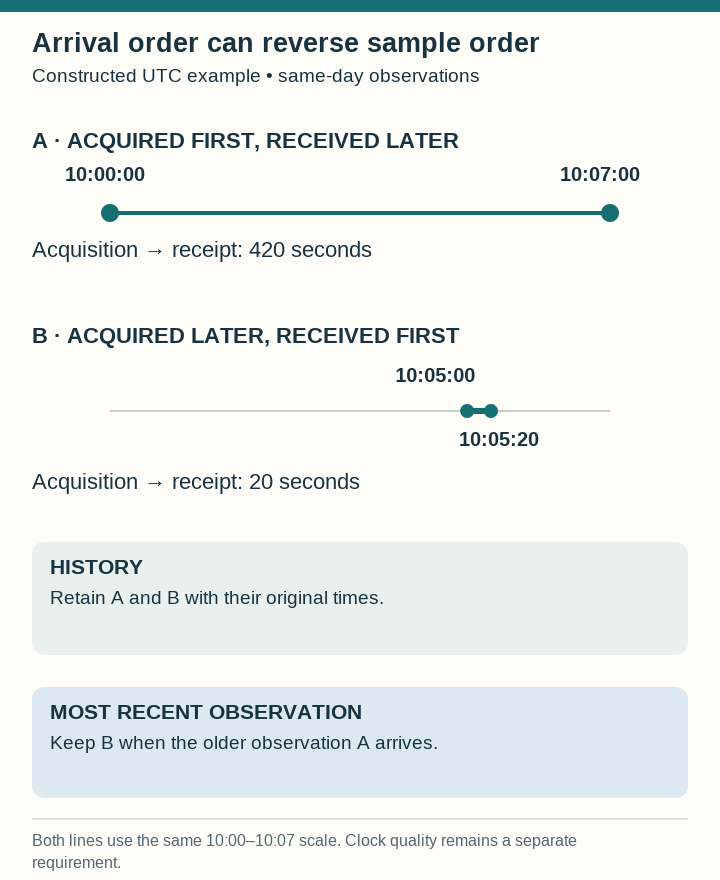
This guide develops an explicit time contract for a small-message system. The examples are constructed and use UTC for comparison. They do not assume that every device has a synchronized clock or that an existing payload already carries acquisition time.
Name the clocks before calculating latency
| Timestamp | What it records | What it does not establish |
|---|---|---|
| Acquired at | The stated time of measurement or event capture | Accuracy of the device clock |
| Received at | Arrival at a named service boundary | When the physical condition occurred |
| Processed at | Completion of a named application step | That a human acted on the result |
Give each field a precise owner. A network timestamp, an HTTP receiver timestamp and a database commit timestamp may all be valid, but they mark different boundaries. Document which one the application uses. Do not rename a convenient service timestamp “measurement time” merely because no other time is available.
Preserve clock quality separately from the timestamp text. Useful states may include synchronized under a defined method, estimated from a reference, device-relative only or unknown. Their names and meanings are application choices. A well-formed timestamp can still be wrong, so syntactic validation and clock validation need separate checks.
Compare two observations in both orders
| Observation | Acquired | Received | Processed | Acquisition-to-receipt difference |
|---|---|---|---|---|
| A | 10:00:00 | 10:07:00 | 10:07:05 | 420 seconds |
| B | 10:05:00 | 10:05:20 | 10:05:24 | 20 seconds |
B arrives first even though A was measured first. When A later arrives, it can improve the historical record without replacing B as the most recent measurement. A “last received value” display would make the wrong choice for a “most recently observed condition” requirement.
The correct behavior depends on the task. An audit view may show both records in acquisition order. A service-monitoring view may show arrival order to diagnose delay. A current-state display may select the newest valid acquisition while showing its age. Preserve enough information to support all three instead of overwriting one timestamp with another.
Use an explicit interchange representation
RFC 3339 defines a timestamp profile with a full date, time and UTC offset. For an application contract, values such as 2026-11-13T10:00:00Z and 2026-11-13T13:00:00+03:00 identify the same instant. A bare 13:00 does not identify a date or offset.
Normalize values for calculation while retaining any original representation needed for diagnosis. Do not sort mixed-offset timestamp strings as if alphabetical order always equaled time order. The standard’s string-ordering property has conditions, including consistent offset representation and fractional precision. Parsing to instants and sorting those instants avoids that shortcut.
For local user displays, label the chosen time zone and keep the underlying instant intact. A report assembled from several sites should not silently switch between device-local time and the viewer’s local time. If a timestamp is unknown, use the contract’s missing representation rather than a fabricated midnight or a default date.
A clock-error example changes the interpretation
Suppose the subtraction gives a twenty-second delay, but the acquisition clock is known only within plus or minus thirty seconds and the receiving clock within plus or minus two seconds. Under those stated error bounds, the difference has a possible error of up to thirty-two seconds.
The timestamp-derived interval is therefore −12 to 52 seconds. Since receipt follows acquisition in this constructed case, negative physical delay is ruled out; the clocks support a bound of zero to 52 seconds, not a precise claim of twenty seconds. The example shows why extra decimal places cannot repair uncertainty in the time references.
If a service requirement depends on a tight deadline, determine how the relevant clocks will be checked and how uncertain observations affect acceptance. A message received before its reported acquisition time should become a diagnostic condition, not automatically be interpreted as a very fast delivery.
Use relative time honestly when wall-clock time is absent
A device can sometimes provide a boot-session identifier and elapsed time since boot without knowing UTC. Those values can establish ordering within the session. They do not establish an absolute acquisition instant unless there is a justified relationship to a time reference.
- Document whether elapsed time includes sleep and what happens when its counter wraps.
- Keep different boot sessions distinct rather than treating a reset as time running backward.
- If estimating wall-clock time, retain the method and uncertainty with the estimate.
- Do not infer accurate acquisition time from receipt when buffering or delay can occur.
The buffering guide shows why this matters after an interruption. A batch of historical records can arrive close together even though acquisition was spread over many hours.
Define late-data behavior for each output
Write separate policies for historical storage, current state and alerts. An old record may be accepted into history but excluded from a current-state update. An alert may need to identify a past exception without pretending that it is still happening. The alert-state guide separates condition, freshness and response.
Keep original receipt time through reprocessing. The callback receiver can record an additional processing revision without changing the original arrival. In an export, include field definitions and time quality so another analyst does not have to guess which timestamp represents the observation.
Test the contract with deliberately out-of-order records, offset-equivalent timestamps, a clock reset and a missing acquisition time. The goal is not merely to make every record fit a date parser. It is to preserve what is known about when the condition occurred and to make uncertainty visible where it changes a decision.