IoT Installation Surveys: Compare Positions With Useful Evidence
Test the intended installation, not just the bare device on a desk. Enclosure, mounting position, nearby materials and ordinary activity can change the conditions under which a small radio device operates. A useful site survey records those conditions and compares practical alternatives without turning a short successful run into a coverage guarantee.
This guide focuses on selecting between allowed mounting options. It complements the broader pilot evaluation guide by making the physical comparison reproducible. All counts below are synthetic; they are not measurements of Sigfox coverage at a real building.
Freeze the things that are not being compared
Sigfox’s antenna guidance explains that an antenna interacts with the surrounding device and installation. Its development guidance also notes that a device’s radiated-performance classification does not guarantee reception after installation. That makes the complete assembly and its position part of the test, rather than incidental details.
Before comparing locations, confirm the proposed device variant and regional configuration with the supplier. Use the intended enclosure, antenna arrangement and firmware. Do not improvise an antenna modification or a mounting arrangement outside the product’s instructions just to improve a trial result.
| Record | Specific entry to retain | Why it matters |
|---|---|---|
| Equipment | Device identifier, model variant and firmware version | Allows the trial to be repeated with the same setup |
| Assembly | Enclosure, approved antenna configuration and power arrangement | A bare development board is a different installation |
| Position | Named mounting point, orientation and relevant nearby materials | “Inside the warehouse” is too broad to reproduce |
| Operating conditions | Door positions, nearby activity and observation window | A quiet empty room may not represent ordinary use |
| Application endpoint | Which receiver and decoder define successful observation | Radio reception and usable application data are different outcomes |
Compare two positions with repeated blocks
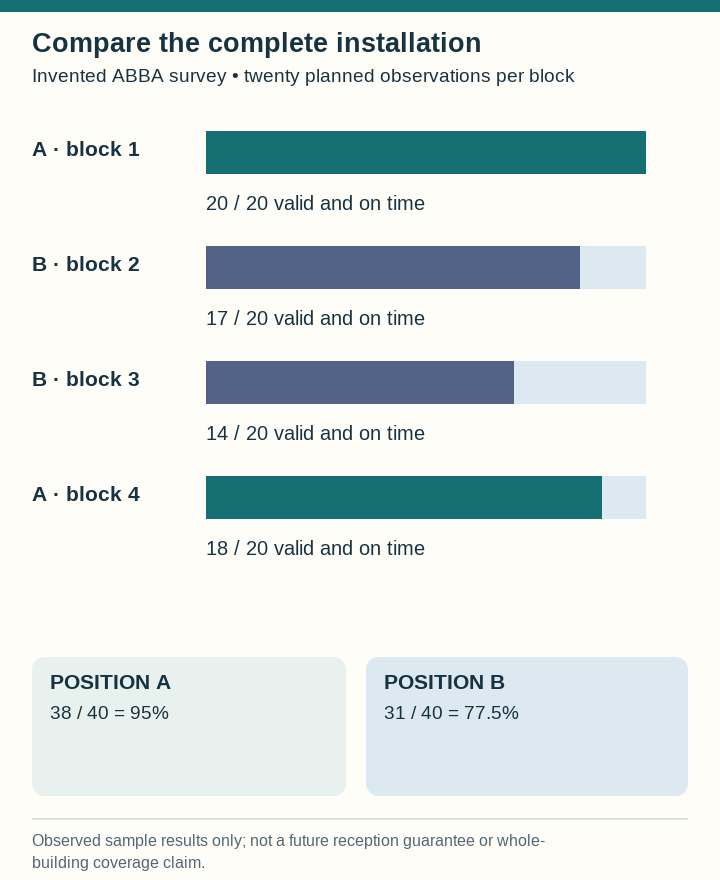
Imagine two manufacturer-permitted positions, A and B, for a device in one building. Run four equal blocks of twenty planned observations in the order A, B, B, A. Keeping a record of the block order helps reveal whether an apparent location difference could instead reflect a changing environment or service condition.
| Block | Position | Expected | Valid and on time | Observed fraction |
|---|---|---|---|---|
| 1 | A | 20 | 20 | 100% |
| 2 | B | 20 | 17 | 85% |
| 3 | B | 20 | 14 | 70% |
| 4 | A | 20 | 18 | 90% |
| Total A | A | 40 | 38 | 95% |
| Total B | B | 40 | 31 | 77.5% |
A has the better observed result in this constructed comparison. The difference is 17.5 percentage points, not proof that position A will deliver 95% in all future conditions. The records may be correlated within a block, and the trial covers only its specified conditions. Repetition at relevant times is more informative than simply adding more rapid messages during one quiet interval.
Keep the denominator honest
The eighty planned observations remain in the record even if some never appear in the application. Counting only the messages that arrived would hide absence. Likewise, multiple receptions or repeated callbacks must not create additional successful scheduled observations. Use the identity rules in the callback guide.
Define “on time” before the comparison and use the same clock boundary for both positions. If the application can only verify receipt time against a planned send schedule, describe that measure accurately. It is not automatically physical-event-to-response latency. The timestamp guide explains the different boundaries.
Record exclusions separately. A device removed because its mounting point was inaccessible represents an installation outcome, not a successful location that should disappear from the proposed deployment count. If a software problem invalidates a block, preserve the original block and explain why the replacement run is needed.
Use layers to investigate failure
When an expected observation is absent, trace it through the available records. Was the sensor sampled? Was a record formed? Did the firmware attempt the scheduled transmission? Did the upstream system show it? Did a callback reach your receiver? Did the decoder accept it? A single missing dashboard point does not identify which boundary failed.
- No local record: investigate sampling, power or firmware behavior.
- Local record, no upstream observation: examine the transmission and installation evidence available.
- Upstream observation, no application record: examine callback configuration, transport and receiver state.
- Application record rejected: investigate schema, validity and processing rules.
The evidence may not expose every layer. State that limitation rather than inventing a radio diagnosis. Keep any available signal-related metadata with its documented meaning, but do not treat one favorable reading as a substitute for the observation-completeness result.
Test the changes the site will actually experience
Choose conditions from the operating process: an enclosure normally closed, stock occupying its usual position, equipment running, or a permitted mounting point used during a busy shift. The aim is a representative comparison, not artificially making a site succeed or fail.
If a condition cannot be tested during the survey, retain it as an open requirement. Do not create unauthorized interference or alter safety equipment to imitate a failure. A planned application interruption can test part of the recovery process without claiming to reproduce a radio outage.
For a movable asset, repeat the comparison at the positions the operating process actually uses. A successful stationary test beside a loading door may say little about the same device after the asset is placed on a storage rack. Give each tested position a stable reference and retain a permitted installation photograph or sketch. Record whether the asset was empty or loaded when that difference could change its surroundings. If the project needs only a checkpoint observation, test that checkpoint explicitly instead of implying continuous visibility throughout an untested journey.
Make the installation decision specific
A useful conclusion identifies the selected position, assembly, tested conditions, observed outcomes and remaining uncertainty. It may recommend a further targeted run, a permitted alternative or rejection of the proposed location. It should not generalize from one mounting point to the entire building.
Carry the selected details into the commissioning record. When a device is replaced, the replacement needs to preserve or deliberately revalidate the installation. A survey has lasting value only when the deployment can be compared with the setup that produced its evidence.