Offline IoT Data Buffering: Capacity, Overflow and Recovery
A local buffer preserves selected information; it does not create connectivity. Before adding a queue to a sensor device, decide which observations deserve storage, how much can be retained and what evidence allows a record to be removed. Otherwise “store and forward” can conceal data loss behind a reassuring label.
This guide uses a constructed periodic recorder. It assumes the firmware can store complete records locally and that an independently specified communication policy determines when they leave the queue. It does not promise that a Sigfox device can detect every missed uplink or receive an acknowledgment for every observation.
Store records with meaning
Define the unit of retention before allocating memory. A record may need a value, validity state, acquisition-time information and an identity that survives delayed transmission. A raw sensor number with no version or time context can be difficult to interpret once it finally reaches the application.
The local format and the radio payload need not be identical. A device might retain richer diagnostic information locally while sending a compact summary. That requires an explicit transformation: which details are omitted, whether the receiver can reconstruct the intended meaning, and how gaps are represented. The payload workshop addresses the message contract; this page addresses what happens before transmission.
| Property | Example design choice | Failure if unspecified |
|---|---|---|
| Identity | Device, local session and observation number | Replayed records can be mistaken for new observations |
| Time | Acquisition time plus a stated clock-quality status | An old measurement can appear current |
| Validity | Valid, sensor unavailable or rejected by local checks | A zero may be mistaken for missing data |
| Removal rule | A documented delivery or retention policy | A transmission attempt can be confused with confirmed acceptance |
Calculate retention from the actual schedule
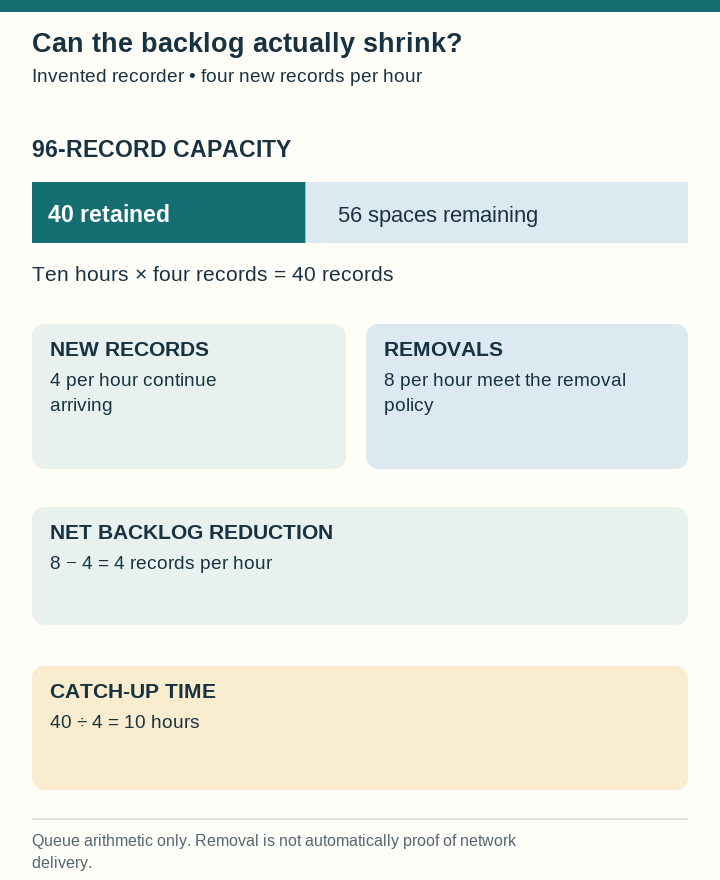
Suppose the recorder produces four records per hour, one every fifteen minutes, and reserves space for 96 complete records. Starting empty, that capacity accommodates 24 hours of scheduled records. This statement describes record count divided by rate; the exact span between the first and last sample also depends on where the schedule begins.
For an assumed ten-hour period with no records removed, 40 records accumulate. If the device was already holding 20 records when that period began, it ends with 60. A capacity calculation that always assumes an empty queue understates the risk of overflow during repeated interruptions.
Memory allocation must include the record structure, indexes, alignment, integrity metadata and any storage-management overhead. Multiplying an application payload length by 96 does not necessarily produce the required allocation. A ring buffer manages a bounded region and wraps its storage position; Zephyr’s documentation describes a FIFO abstraction, not automatic nonvolatile durability or a complete observation protocol.
Check whether the backlog can shrink
In a simplified recovery model, new records continue arriving at four per hour and eight records per hour leave the queue. The backlog shrinks by four per hour. Clearing the 40-record backlog therefore takes ten hours, assuming those rates remain constant and every removal satisfies the stated policy.
| Removal rate | New-record rate | Net queue change | Consequence |
|---|---|---|---|
| 8 records/hour | 4 records/hour | −4 records/hour | Ten hours to clear the initial backlog |
| 4 records/hour | 4 records/hour | 0 | Backlog does not shrink |
| 3 records/hour | 4 records/hour | +1 record/hour | Queue continues growing |
These are queue rates, not recommended radio transmission rates or a statement about a subscription allowance. The real communication schedule must satisfy the applicable device, regional and service constraints. A recovery burst that looks attractive in a spreadsheet may be unavailable or may use more energy than the operating plan allows. Reconcile it with the battery budget.
Choose what overflow means
There are several defensible overflow policies, but they preserve different information. Dropping the oldest record favors recent state. Refusing new records preserves the beginning of an interruption. Keeping an aggregate may preserve a count or range while losing individual timing. None should be described as lossless.
- Recent-state use: retain newer observations and record how many older records were discarded.
- Audit-first use: preserve the earliest records and expose the point at which recording stopped.
- Summary use: define the count, time window and aggregation method, including invalid samples.
If events have priority over routine samples, allocate and test that policy explicitly. Otherwise routine traffic may occupy the entire queue before an event occurs. A reserved space is useful only if the software enforces it and the receiver understands the different records. Test a sustained event burst as well as the ordinary schedule.
Distinguish a RAM queue from a durable log
A buffer in volatile memory does not, by itself, survive a power interruption. Nonvolatile storage raises additional questions about incomplete writes, recovery and write endurance. Use the selected component’s documentation and a tested record format; a circular index alone does not make a partially written record valid.
A useful fault test interrupts power at controlled points while storing a record, then checks which previously committed records are recoverable and how the incomplete one is identified. Perform this on authorized test hardware with an appropriate procedure. The expected outcome should be written before testing, including whether loss of the newest record is permitted.
Tell the receiver what it is looking at
Replayed records should retain their acquisition identity and time information. Their receipt time is new, but their observed condition is old. The late-data guide explains why a historical record may belong in an archive without replacing the current-state display.
Also distinguish a device-side queue from the server queue in the callback receiver. One preserves observations before their upstream handoff; the other preserves accepted requests before application processing. Each needs its own capacity, failure and removal rules. Test both together, because successful recovery at one boundary cannot recover a record already discarded at another.
A useful handover includes the record layout, maximum count, normal and recovery rates, overflow counters, power-loss behavior and a worked replay trace. With those details, “buffered” becomes a testable property rather than a substitute for a delivery requirement.